














Why AI Agents Are Becoming the Backbone of Modern Business Automation

Written By

Ananyaa G

Published on

January 23, 2026

Read Time

10 Minutes

Business automation is entering a new era. What once relied on static scripts and rule-based workflows is now being reshaped by AI agents—autonomous systems capable of understanding context, making decisions, and continuously improving how work gets done.

Organizations today face mounting operational pressure: higher customer expectations, increasing data volumes, complex compliance requirements, and limited human capacity. Traditional automation tools can no longer keep pace with this complexity. 

As a result, businesses are turning to AI-powered automation solutions that can operate intelligently rather than mechanically. Organizations can design and implement AI agents for business automation that go beyond task execution. These systems are built to support real operational needs—streamlining workflows, improving accuracy, and enabling scalable growth without increasing overhead.

Vector2AI works with organizations to implement business-ready AI agents that integrate into existing workflows rather than replacing them abruptly. This approach ensures automation enhances operations without disrupting teams.

What Are AI Agents in Business Automation?

AI agents are autonomous software systems designed to observe data, analyze situations, make decisions, and take action in pursuit of defined business objectives. Unlike basic automation scripts, AI agents can handle variability, ambiguity, and evolving conditions.

In business environments, AI agents are commonly used to:      

  • Automate complex workflows across multiple systems
  • Process structured and unstructured data
  • Make context-aware decisions
  • Reduce reliance on constant human supervision

Bridge the gap between data and action with autonomous AI agents. Let Vector2AI help you discover the most effective automation strategies for your unique business objectives.

AI Agents vs Traditional Automation: A Fundamental Shift

Limitations of Rule-Based Automation

Traditional automation systems depend on predefined logic:

  • Fixed rules for every scenario
  • Manual updates when processes change
  • Limited ability to handle exceptions
  • Minimal learning or improvement over time

These systems work well for repetitive, predictable tasks—but break down when workflows involve human judgment, dynamic inputs, or unstructured information.

How AI Agents Change the Model

AI agents introduce intelligence and adaptability into automation. Instead of executing rigid instructions, they evaluate context, assess options, and choose appropriate actions.

Key differences include:

Traditional Automation

AI Agent Automation

Static rules

Adaptive decision-making

Manual reconfiguration

Continuous learning

Structured data only

Structured + unstructured data

Limited scalability

Designed for complex workflows

Businesses can transition from basic automation to agent-based automation systems that are designed to scale with organizational complexity.

Core Capabilities of AI Agents Developed for Business Use

Modern AI agents combine multiple AI technologies into a single operational system. You have to focus on aligning these capabilities with real business outcomes.

Autonomous Workflow Management

AI agents can coordinate multi-step processes across departments, tools, and data sources—reducing handoffs and delays.

Examples include:

  • Managing internal approval workflows
  • Coordinating customer onboarding steps
  • Orchestrating data movement between systems

Natural Language Understanding

AI agents can read and interpret emails, documents, chat messages, and forms. This enables automation in areas previously dependent on manual review.

Learning and Optimization

Through machine learning, AI agents refine decisions based on historical outcomes—improving efficiency and accuracy over time.

Context-Aware Decision Making

Rather than following a single rule path, AI agents assess situational factors such as urgency, compliance constraints, or business priorities before acting.

Stop manual reviews with context-aware AI agents. Vector2AI identifies high-ROI workflows to automate your most complex documentation.

High-Impact Use Cases for AI Agents in Business Automation

Intelligent Workflow Automation

AI agents are increasingly used to automate workflows that span multiple systems. Instead of automating individual tasks, they manage entire processes end to end.

Vector2AI supports organizations in identifying workflows where AI-driven orchestration delivers the highest ROI.

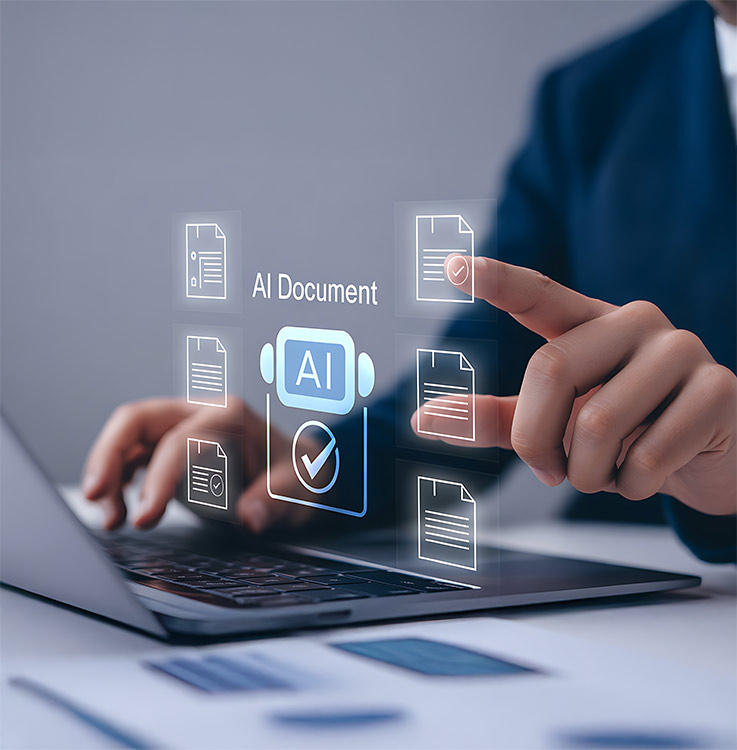
Document Processing and Data Extraction

Document-heavy operations are one of the most common automation bottlenecks.

AI agents can:      

  • Extract key data from documents
  • Validate information against business rules
  • Route outputs to the correct systems

This is particularly valuable in industries such as finance, healthcare, legal services, and operations-heavy enterprises.

Customer Operations and Support Automation

AI agents used in customer-facing roles now go far beyond scripted chat responses. They can:

  • Understand customer intent
  • Access relevant data
  • Escalate complex issues intelligently

Measuring the Business Value of AI Agent Automation

Organizations implementing AI agents typically measure success across four core areas:

Operational Efficiency

  • Faster process completion
  • Reduced manual intervention
  • Increased throughput

Accuracy and Quality

  • Lower error rates
  • Improved data consistency
  • Fewer compliance issues

Cost Optimization

  • Reduced operational overhead
  • Better resource allocation
  • Scalable growth without proportional staffing increases

Experience Improvements

  • Faster customer responses
  • Reduced employee workload
  • More consistent service delivery

Defining clear performance metrics before implementation is critical to ensure AI automation aligns with business goals.

Ready to scale without increasing overhead? Vector2AI helps you define and capture the core metrics that prove AI automation value.

The Technology Stack Behind AI Agents

AI agents rely on a carefully designed technology foundation. It is important to focus on practical, scalable architectures rather than experimental complexity.

Large Language Models (LLMs)

LLMs enable AI agents to understand and generate natural language, making them effective in document processing, communication workflows, and decision support.

Machine Learning and Predictive Models

These models allow AI agents to recognize patterns, forecast outcomes, and recommend actions based on historical data.

System Integration and APIs

AI agents must work within existing technology ecosystems. Vector2AI emphasizes seamless integration with business systems such as CRMs, ERPs, and internal tools.

Security and Governance

Enterprise automation requires:

  • Secure data handling
  • Role-based access controls
  • Auditable decision trails

AI Agents for Small and Mid-Sized Businesses

AI agents are no longer exclusive to large enterprises. Cloud-based deployments and modular architectures have made intelligent automation accessible to smaller teams.

Common small business use cases include:

  • Customer inquiry handling
  • Appointment scheduling
  • Order and inventory tracking
  • Marketing and sales automation

Vector2AI helps small and mid-sized organizations start with focused automation initiatives that deliver quick wins, then expand as needs grow.

A Step-by-Step Approach to Implementing AI Agents

Step 1

Identify Automation Opportunities


Focus on high-volume, repetitive, or error-prone processes.


Step 2

Pilot AI Agent Deployment


Start small to validate performance and gather feedback.


Step 3

Integrate with Core Systems


Ensure AI agents operate within existing workflows rather than creating silos.


Step 4

Scale and Optimize


Expand successful use cases while continuously monitoring performance.

Security, Compliance, and Responsible AI Automation

As AI agents gain autonomy, governance becomes critical. Businesses must ensure:

  • Data privacy protections
  • Transparent decision-making
  • Regulatory compliance

The Future of Business Automation with AI Agents

AI agents will continue evolving toward:

  • More proactive decision-making
  • Better collaboration with human teams
  • Deeper integration across business systems

Rather than replacing people, AI agents will increasingly serve as operational partners, handling complexity so teams can focus on strategy and innovation.

Next Stop: Business-Ready AI Agents

AI agents represent a practical, scalable path forward for business automation. When designed correctly, they reduce friction, improve accuracy, and enable sustainable growth.

By aligning intelligent automation with business objectives, organizations can move from manual workflows to intelligent operations—confidently and responsibly.

The future of automation isn’t just faster processes. It’s smarter systems working alongside people to create more resilient, efficient businesses

Ready to transition from manual workflows to intelligent automations? Vector2AI builds the bridge between your current stack and AI-driven growth.

Get In Touch