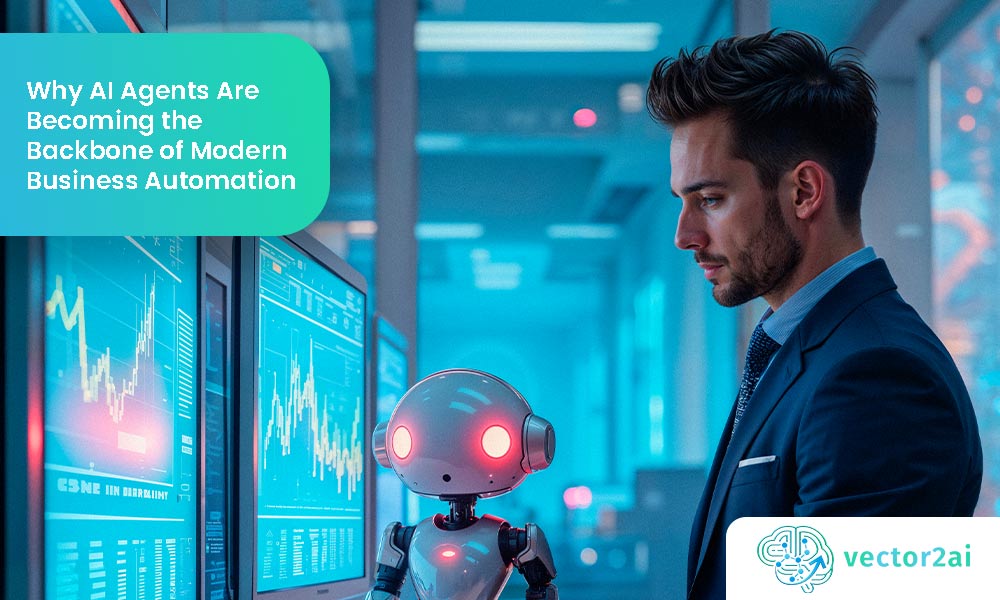













Why AI Agents Are Becoming the Backbone of Modern Business Automation
Written By
Ananyaa G
Published on
January 23, 2026
Read Time
10 Minutes
Business automation is entering a new era. What once relied on static scripts and rule-based workflows is now being reshaped by AI agents—autonomous systems capable of understanding context, making decisions, and continuously improving how work gets done.
Organizations today face mounting operational pressure: higher customer expectations, increasing data volumes, complex compliance requirements, and limited human capacity. Traditional automation tools can no longer keep pace with this complexity.
As a result, businesses are turning to AI-powered automation solutions that can operate intelligently rather than mechanically. Organizations can design and implement AI agents for business automation that go beyond task execution. These systems are built to support real operational needs—streamlining workflows, improving accuracy, and enabling scalable growth without increasing overhead.
Vector2AI works with organizations to implement business-ready AI agents that integrate into existing workflows rather than replacing them abruptly. This approach ensures automation enhances operations without disrupting teams.
What Are AI Agents in Business Automation?
AI agents are autonomous software systems designed to observe data, analyze situations, make decisions, and take action in pursuit of defined business objectives. Unlike basic automation scripts, AI agents can handle variability, ambiguity, and evolving conditions.
In business environments, AI agents are commonly used to:
- Automate complex workflows across multiple systems
- Process structured and unstructured data
- Make context-aware decisions
- Reduce reliance on constant human supervision
Bridge the gap between data and action with autonomous AI agents. Let Vector2AI help you discover the most effective automation strategies for your unique business objectives.
AI Agents vs Traditional Automation: A Fundamental Shift
Limitations of Rule-Based Automation
Traditional automation systems depend on predefined logic:
- Fixed rules for every scenario
- Manual updates when processes change
- Limited ability to handle exceptions
- Minimal learning or improvement over time
These systems work well for repetitive, predictable tasks—but break down when workflows involve human judgment, dynamic inputs, or unstructured information.
How AI Agents Change the Model
AI agents introduce intelligence and adaptability into automation. Instead of executing rigid instructions, they evaluate context, assess options, and choose appropriate actions.
Key differences include:
Traditional Automation | AI Agent Automation |
Static rules | Adaptive decision-making |
Manual reconfiguration | Continuous learning |
Structured data only | Structured + unstructured data |
Limited scalability | Designed for complex workflows |
Businesses can transition from basic automation to agent-based automation systems that are designed to scale with organizational complexity.
Core Capabilities of AI Agents Developed for Business Use
Modern AI agents combine multiple AI technologies into a single operational system. You have to focus on aligning these capabilities with real business outcomes.
Autonomous Workflow Management
AI agents can coordinate multi-step processes across departments, tools, and data sources—reducing handoffs and delays.
Examples include:
- Managing internal approval workflows
- Coordinating customer onboarding steps
- Orchestrating data movement between systems
Natural Language Understanding
AI agents can read and interpret emails, documents, chat messages, and forms. This enables automation in areas previously dependent on manual review.
Learning and Optimization
Through machine learning, AI agents refine decisions based on historical outcomes—improving efficiency and accuracy over time.
Context-Aware Decision Making
Rather than following a single rule path, AI agents assess situational factors such as urgency, compliance constraints, or business priorities before acting.
Stop manual reviews with context-aware AI agents. Vector2AI identifies high-ROI workflows to automate your most complex documentation.
High-Impact Use Cases for AI Agents in Business Automation
Intelligent Workflow Automation
AI agents are increasingly used to automate workflows that span multiple systems. Instead of automating individual tasks, they manage entire processes end to end.
Vector2AI supports organizations in identifying workflows where AI-driven orchestration delivers the highest ROI.
Document Processing and Data Extraction
Document-heavy operations are one of the most common automation bottlenecks.
AI agents can:
- Extract key data from documents
- Validate information against business rules
- Route outputs to the correct systems
This is particularly valuable in industries such as finance, healthcare, legal services, and operations-heavy enterprises.
Customer Operations and Support Automation
AI agents used in customer-facing roles now go far beyond scripted chat responses. They can:
- Understand customer intent
- Access relevant data
- Escalate complex issues intelligently
Measuring the Business Value of AI Agent Automation
Organizations implementing AI agents typically measure success across four core areas:
Operational Efficiency
- Faster process completion
- Reduced manual intervention
- Increased throughput
Accuracy and Quality
- Lower error rates
- Improved data consistency
- Fewer compliance issues
Cost Optimization
- Reduced operational overhead
- Better resource allocation
- Scalable growth without proportional staffing increases
Experience Improvements
- Faster customer responses
- Reduced employee workload
- More consistent service delivery
Defining clear performance metrics before implementation is critical to ensure AI automation aligns with business goals.
Ready to scale without increasing overhead? Vector2AI helps you define and capture the core metrics that prove AI automation value.
The Technology Stack Behind AI Agents
AI agents rely on a carefully designed technology foundation. It is important to focus on practical, scalable architectures rather than experimental complexity.
Large Language Models (LLMs)
LLMs enable AI agents to understand and generate natural language, making them effective in document processing, communication workflows, and decision support.
Machine Learning and Predictive Models
These models allow AI agents to recognize patterns, forecast outcomes, and recommend actions based on historical data.
System Integration and APIs
AI agents must work within existing technology ecosystems. Vector2AI emphasizes seamless integration with business systems such as CRMs, ERPs, and internal tools.
Security and Governance
Enterprise automation requires:
- Secure data handling
- Role-based access controls
- Auditable decision trails
AI Agents for Small and Mid-Sized Businesses
AI agents are no longer exclusive to large enterprises. Cloud-based deployments and modular architectures have made intelligent automation accessible to smaller teams.
Common small business use cases include:
- Customer inquiry handling
- Appointment scheduling
- Order and inventory tracking
- Marketing and sales automation
Vector2AI helps small and mid-sized organizations start with focused automation initiatives that deliver quick wins, then expand as needs grow.
A Step-by-Step Approach to Implementing AI Agents
Identify Automation Opportunities
Focus on high-volume, repetitive, or error-prone processes.
Pilot AI Agent Deployment
Start small to validate performance and gather feedback.
Integrate with Core Systems
Ensure AI agents operate within existing workflows rather than creating silos.
Scale and Optimize
Expand successful use cases while continuously monitoring performance.
Security, Compliance, and Responsible AI Automation
As AI agents gain autonomy, governance becomes critical. Businesses must ensure:
- Data privacy protections
- Transparent decision-making
- Regulatory compliance
The Future of Business Automation with AI Agents
AI agents will continue evolving toward:
- More proactive decision-making
- Better collaboration with human teams
- Deeper integration across business systems
Rather than replacing people, AI agents will increasingly serve as operational partners, handling complexity so teams can focus on strategy and innovation.
Next Stop: Business-Ready AI Agents
AI agents represent a practical, scalable path forward for business automation. When designed correctly, they reduce friction, improve accuracy, and enable sustainable growth.
By aligning intelligent automation with business objectives, organizations can move from manual workflows to intelligent operations—confidently and responsibly.
The future of automation isn’t just faster processes. It’s smarter systems working alongside people to create more resilient, efficient businesses
Ready to transition from manual workflows to intelligent automations? Vector2AI builds the bridge between your current stack and AI-driven growth.
Hari Subramanian
Principal AI Consultant

Hari Subramanian is a seasoned technology leader with over three decades of experience, most recently leading Engineering for the AI Center of Enablement at CIGNA, where he drove business growth and efficiency through scalable AI solutions and enterprise-wide AI governance platforms.
He has led data integration, data engineering, and cloud-based claims platforms at CIGNA, driving digital transformation and advanced analytics. He implemented open-source, cloud-based API and claims platforms capable of processing more than 12 billion transactions annually and brings deep technology consulting experience across Healthcare, Life Sciences, and Financial Services.
He has held senior leadership roles at Cognizant and DXC Technologies, aligning business strategy with technology for Global 500 clients, and has a proven track record of building global, high-performance teams while delivering large-scale transformation programs using agile and lean practices. He holds an Engineering degree from Anna University, certifications from Cornell in Executive Leadership and MIT in Generative AI, and serves as a Strategic Advisor to TrueFoundry and Athena Security Group.
Kalyan Tirunelveli
Co-Founder

Kalyan “Kal” Tirunelveli is a seasoned technology executive with over 30 years of experience leading global IT strategy and operations at companies including Hewlett Packard, Travelocity, and American Airlines. He brings deep expertise in building scalable technology organizations and driving transformation across complex, global environments.
He has led global IT strategy, operations, and large-scale transformation initiatives across Fortune 500 enterprises, bringing extensive experience in enterprise infrastructure, applications, and operational excellence. He is known for aligning business objectives with technology strategy to deliver measurable outcomes and holds advanced degrees in Computer Science and Electronics Engineering, along with multiple industry-recognized IT certifications. Outside of his professional work, he is a certified tennis instructor and youth coach, reflecting a strong commitment to mentorship and community development.
Kal is the founder of Arokia IT LLC, based in Southlake, Texas, USA. Kal specializes in providing technical solutions for customer pain points. Arokia provides various end-to-end IT services like e-commerce websites, open source applications, mobile apps, and digital marketing. No detail is ever overlooked with Kal – his analytical nature allows him to focus on all strategy aspects and ensure any goals are met. By listening to others and putting himself in others’ shoes, Kal is able to bring a clear project vision to life. In his IT Management Career, Kalyan has managed technical infrastructure, data security architecture, and security policy for several clients, including ABN AMRO, American Airlines, Dollar, Sabre, Travelocity, US Airways, Amtrak, and London Underground Limited.
Ananyaa Gautham
Co-Founder

Ananyaa operates at the intersection of Analytics, Artificial Intelligence, and Strategic IT consulting, driving the technical vision and cross-industry excellence of the firm. She has successfully led high-impact initiatives across the industrial, manufacturing, healthcare, energy, construction, and legal sectors, with expertise centering on workflow optimization via AI enablement, product roadmaps, and digital marketing strategy. As a technical liaison, she excels at bridging the gap between cross-functional teams and stakeholders, overseeing end-to-end implementations to ensure that complex custom software and AI-enabled solutions deliver both innovation and measurable strategic outcomes.
Drawing on her foundational background as an RF Engineer and a certified Salesforce Administrator, she applies analytical design principles and a process-oriented lens to drive execution excellence. Her career includes developing communication systems at Nokia Siemens Networks and later working as an Independent Consultant, leading several engagements across diverse technology landscapes. Ananyaa holds a Master’s degree in Engineering. Outside her professional work, she is a classical music instructor and enjoys baking and creative arts.

