What is Generative AI? How It Works, Tools, Uses, and Risks
Written By
vector2Ai
Published on
September 5, 2026
Read Time
15 Minutes
Generative AI has moved from a niche research topic to a technology that shapes how millions of people write, design, code, and make decisions every day. At its core, generative AI is a branch of artificial intelligence that creates new content, text, images, audio, video, and code, rather than simply analyzing or sorting existing data. It sits within a clear hierarchy: artificial intelligence contains machine learning, which contains deep learning, which contains generative AI.
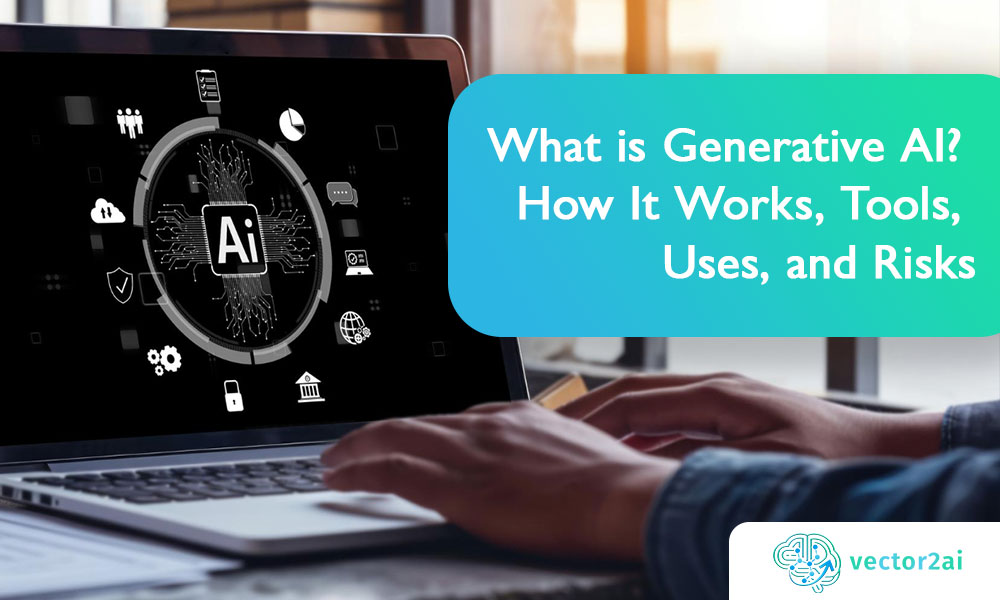

Modern systems work by training large neural networks on massive datasets, learning statistical patterns, and then using those patterns to generate original output from a prompt. This has given rise to large language models, foundation models, and a growing ecosystem of tools spanning chatbots, image generators, coding assistants, and voice synthesis platforms. Businesses are adopting these tools at speed, using them for marketing, customer support, software development, education, and healthcare documentation, though healthcare and other high-stakes fields still require human oversight.
The benefits are real: faster output, lower costs, and easier access to professional-quality work. So are the limitations: factual errors, bias, and uneven reliability. Risks around privacy, misinformation, security, intellectual property, and job displacement mean organizations need clear policies and human review processes. Used thoughtfully, with clear goals, well-structured prompts, and a human always checking the output, generative AI is a genuinely useful tool. This article walks through what it is, how it works, where it’s headed, and how to use it effectively.
What is Generative AI?
Generative AI is a category of artificial intelligence that creates new content instead of just analyzing or sorting existing data. Give it a prompt, and it produces text, images, audio, video, or code that didn’t exist before. It does this by learning patterns from massive datasets and then using those patterns to generate original output.
Semantic triple: Generative AI — creates — new content from learned patterns.


Examples of Generative AI
You’ve probably used generative AI without thinking of it that way. A few concrete examples:
- Typing a question into ChatGPT and getting a written answer
- Asking Midjourney or DALL-E to turn a text description into an image
- Using GitHub Copilot to auto-complete a block of code
- Generating a voiceover with an AI tool like ElevenLabs
- Creating a short video clip from a text prompt using Sora or Runway
Each of these tools takes an input, usually text, and generates something new, rather than retrieving something that already exists.
How is Generative AI Different From Traditional AI?
Traditional AI and generative AI solve different kinds of problems. Traditional AI is built to recognize, sort, or predict. It looks at data and decides what category something belongs to, what number comes next, or whether a transaction looks fraudulent. Generative AI goes a step further by producing new material that resembles, but doesn’t copy, the data it was trained on.

Traditional AI:
- Analyzes existing data
- Produces a label, score, or prediction
- Example: a spam filter marking an email as spam or not spam
- Example: a credit scoring model predicting default risk
Generative AI:
- Learns patterns from existing data
- Produces new content that didn’t exist before
- Example: a tool that writes a draft email for you
- Example: a model that generates a product image from a text description
The simplest way to remember the difference: traditional AI answers “what is this,” while generative AI answers “what can I create.”
Is Generative AI a Subset of Deep Learning?
Yes. Generative AI sits inside deep learning, which itself sits inside machine learning, which sits inside the broader field of artificial intelligence. Deep learning uses layered neural networks to find patterns in data, and generative AI applies those networks specifically to the task of producing new content rather than just classifying or predicting it.


What is the Primary Focus of Generative AI?
The primary focus of generative AI is content creation, not decision automation. This distinction matters because it shapes what these tools are good at and what they’re not built for.
What generative AI is optimized for:
- Producing new text, images, audio, video, or code
- Synthesizing information into a new, coherent form
- Adapting output style, tone, and format based on instructions
What it is not primarily built for:
- Making autonomous business decisions
- Replacing structured prediction systems like fraud detection or demand forecasting
- Guaranteeing factual accuracy without human review
While traditional AI systems are optimized to answer “what is this” or “what will happen next,” generative AI’s core job is to synthesize new, relevant, and useful content in response to a prompt.
How Does Generative AI Work?
Generative AI models go through a multi-stage process before they can generate anything useful. Understanding these stages makes it much easier to understand both the strengths and the limitations of the technology.

1. Data collection and training
Models are trained on enormous datasets, text scraped from books and websites, image and caption pairs, audio recordings, or code repositories. The quality, diversity, and scale of this training data directly shapes what the model can eventually generate.
2. Pattern learning
During training, the model repeatedly tries to predict a missing or next piece of information, the next word in a sentence, the next pixel region in an image, and adjusts its internal parameters based on how close its prediction was. This happens billions of times, gradually building an internal representation of language, imagery, or sound.

3. The transformer architecture
Most modern generative AI systems, including large language models, are built on transformer architecture. Transformers use a mechanism called attention, which lets the model weigh how relevant different parts of the input are to each other, regardless of their position. This is what allows a model to understand that “it” in a sentence refers back to a noun mentioned several words earlier, or that a specific brushstroke in an image relates to an object described elsewhere in the prompt.
4. Fine-tuning and alignment
After initial training, many models go through additional rounds of fine-tuning, often using human feedback, to make responses more accurate, safer, and better aligned with what users actually want. This stage is where a raw, general-purpose model becomes a usable product like a chatbot or coding assistant.

5. Inference (generation)
Once trained, the model is ready to generate content. When you type a prompt, the model doesn’t look up a stored answer. It generates output token by token, or pixel region by pixel region, predicting the most statistically plausible continuation based on everything it learned during training and the specific context of your prompt.
6. Diffusion models for images and video
Image and video generators typically work differently from text models. They use diffusion, starting with random visual noise and gradually refining it step by step until it forms a coherent image or video sequence that matches the prompt.
This layered process explains both why generative AI can produce impressively fluent, creative output, and why it can also generate confident-sounding errors: it’s predicting plausible patterns, not retrieving verified facts.

What Are AI Models?
An AI model is the trained system itself, the file and set of parameters that store everything the system learned during training. Think of it as the engine under the hood. When you interact with ChatGPT or Midjourney, you’re really interacting with a model that has been packaged into a usable product.
What Are Large Language Models (LLMs)?
Large language models are AI models trained specifically on text, at massive scale, to understand and generate human language. LLMs power most modern AI chatbots and writing tools. They’re called “large” because they contain billions, sometimes over a trillion, of parameters, the internal values the model adjusts during training to capture patterns in grammar, facts, reasoning, and style.


What Are Foundation Models?
Foundation models are large-scale models trained on broad, diverse data that can then be adapted to many different tasks, rather than being built for just one job. GPT, Gemini, and Claude are all foundation models. A company can take a foundation model and fine-tune it for customer support, legal document review, or medical coding without training a new model from scratch.
What Are Types of Generative AI?
Generative AI isn’t a single technology; it’s a set of related approaches, each specialized for a different kind of content.
Text Generation
Text generation models write essays, emails, summaries, code comments, and conversational replies. They’re built on large language models trained on enormous volumes of written material. Applications include drafting business communications, summarizing long documents, translating between languages, and holding open-ended conversations. Text generation is the most mature and widely used category of generative AI today, largely because language data is abundant and text is useful across nearly every industry.
Image Generation
Image generators turn text descriptions into original visuals. Tools like Midjourney, DALL-E, and Stable Diffusion use diffusion models, which start with random noise and gradually refine it into a coherent image that matches the prompt. These tools support use cases from marketing graphics and concept art to product mockups and architectural visualization. Users can control style, composition, lighting, and subject matter through detailed prompting, and many tools now support editing existing images, not just generating new ones from scratch.


Video Generation
Video generation is newer and more computationally demanding than image generation, since it has to keep objects, lighting, camera movement, and motion consistent across many frames rather than a single still image. Tools such as Sora and Runway generate short clips from text prompts, and some now support extending existing footage or animating a still image. Quality and clip length have improved sharply over the past two years, though full-length, production-ready video generation is still an active area of development.
Audio and Music Generation
Audio generation tools create voiceovers, sound effects, and full musical compositions. Some clone a specific voice from a short sample, useful for dubbing, audiobooks, and accessibility tools, while others compose original music in a requested genre, mood, or tempo based purely on a text description. This category is increasingly used in podcasting, video production, and game development, where custom audio used to require significant studio time and cost.


Code Generation
Code generation tools write, complete, explain, and refactor code across dozens of programming languages. They’re typically trained on large volumes of public code repositories combined with documentation, and they can generate entire functions, suggest bug fixes, translate code between languages, and explain unfamiliar codebases. This category has become one of the most enterprise-tested applications of generative AI, since developers can quickly verify whether generated code actually works.
What Are the Most Popular Generative AI Tools?
The most popular generative AI tools are listed below:

AI Chat Agents
What they do: Hold natural, back-and-forth conversations, answer questions, draft content, and reason through multi-step problems.
Who they’re for: Students, professionals, researchers, and anyone who needs quick answers or a thinking partner.
Common use cases: Research, tutoring, brainstorming, coding help, customer support, and general problem-solving.
Notable tools: ChatGPT (OpenAI), Claude (Anthropic), and Gemini (Google) are the major general-purpose chatbots, each with different strengths in reasoning, writing style, and integration with other software.
AI Writing Tools
What they do: Help draft, edit, and polish written content, from blog posts to business proposals, often with built-in grammar, tone, and style suggestions.
Who they’re for: Marketers, content teams, students, and small business owners who need to produce written material quickly.
Common use cases: Blog posts, ad copy, email campaigns, grammar and tone editing, resume and cover letter writing.


AI Image Generators
What they do: Convert text prompts into original images, illustrations, and design concepts, and increasingly allow editing of existing images.
Who they’re for: Designers, marketers, social media managers, and hobbyist creators.
Common use cases: Marketing visuals, concept art, product mockups, social media graphics, and rapid design prototyping.
AI Video Generators
What they do: Produce short video clips, animations, or edited footage from text prompts or existing media.
Who they’re for: Video editors, social media creators, and marketing teams needing quick turnaround content.
Common use cases: Social ads, explainer videos, product demos, and storyboarding for larger productions.


AI Coding Assistants
What they do: Autocomplete code, suggest fixes, explain unfamiliar codebases, and generate entire functions from natural language descriptions.
Who they’re for: Software developers of every experience level, from students to senior engineers.
Common use cases: Writing boilerplate code, debugging, code review, learning new languages or frameworks, and speeding up repetitive coding tasks.
AI Voice and Audio Tools
What they do: Generate synthetic voices, clone existing voices, and compose music or sound effects.
Who they’re for: Podcasters, video producers, game developers, and musicians.
Common use cases: Voiceovers, dubbing, audiobook narration, background music for videos, and accessibility features like text-to-speech.

What Are the Applications of Generative AI?
The applications of generative AI are listed below:
Generative AI in Marketing
Marketing teams use generative AI to speed up content creation across channels: blog posts, social captions, product descriptions, and email campaigns. It helps write ad copy variations for A/B testing, personalize messaging based on customer segments, brainstorm campaign concepts, and assist with SEO tasks like keyword clustering and meta description drafts.
Generative AI in Education
In classrooms and self-directed learning, generative AI acts as a tutor that explains concepts at the learner’s pace, generates practice questions and study guides, helps teachers draft lesson plans, and summarizes dense reading material into digestible notes. It also supports personalized learning paths, adjusting explanations and difficulty based on how a student is progressing.
Generative AI in Healthcare
Generative AI shows real promise in healthcare, from drafting clinical documentation and summarizing patient records to assisting with medical research and drug discovery. However, healthcare is a domain where accuracy and accountability matter enormously. AI-generated summaries, suggestions, or draft notes should always be reviewed by a licensed medical professional before they influence a diagnosis or treatment decision. No generative AI tool should replace clinical judgment, and outputs used in patient care need the same oversight as any other clinical resource.
Generative AI in Software Development
Developers use generative AI throughout the coding lifecycle: generating boilerplate and functions from natural language descriptions, spotting and explaining bugs, writing unit tests, and producing documentation for existing codebases. This has become one of the clearest productivity wins in the technology, letting engineers spend more time on architecture and problem-solving and less on repetitive syntax.
Generative AI in Business
Beyond marketing and development, generative AI supports customer service teams by drafting responses and powering chatbots, helps analysts summarize data and generate reports, and powers internal knowledge assistants that let employees ask questions about company policies or documentation instead of searching through folders. It also automates repetitive workflow steps like data entry and routine correspondence.
Generative AI in Creative Industries
In creative fields, generative AI assists rather than replaces the creative process for most professionals. Writers use it to overcome blank-page syndrome and draft outlines. Graphic designers use it to rapidly prototype visual concepts. Musicians experiment with AI-generated melodies as a starting point. Filmmakers use it for storyboarding and previsualization. Advertisers generate multiple creative directions quickly for client review, and game developers use it to generate concept art, dialogue drafts, and environmental textures.
What Are Benefits of Generative AI?
The benefits of generative AI are listed below:
- Speed: Drafts, summaries, and first passes on creative work that used to take hours can be produced in seconds.
- Cost efficiency: Teams can produce more content and code without proportionally increasing headcount.
- Accessibility: People without specialized design, coding, or writing skills can produce professional-looking output.
- Personalization at scale: Businesses can tailor messaging, recommendations, and learning material to individuals rather than broad segments.
- Idea generation: It’s a strong brainstorming partner, surfacing angles or options a person might not have considered.
What Are the Limitations of Generative AI?
Generative AI is powerful, but it has structural limitations that come directly from how it’s built and trained. Understanding these helps set realistic expectations for what the technology can and can’t reliably do.
Factual errors (hallucination)
Because models generate the most statistically plausible response rather than retrieve verified facts, they can produce confident, well-written statements that are simply wrong. This is especially common with specific numbers, dates, citations, and niche topics that were underrepresented in training data.
Lack of true understanding
These systems predict plausible patterns rather than reason the way humans do. They don’t have beliefs, intentions, or genuine comprehension of the world. This shows up in edge cases, unusual requests, or tasks that require common-sense judgment the model hasn’t seen modeled clearly in its training data.
Inconsistent output quality
The same prompt can produce noticeably different results on different attempts, and output quality depends heavily on how clearly the prompt is written. This inconsistency makes generative AI harder to rely on for tasks that need guaranteed, repeatable precision.
Limited real-time knowledge
Most models have a training cutoff date and don’t automatically know about recent events, prices, or developments unless they’re specifically connected to live data sources like web search. Ask about something that happened after that cutoff, and the model may either say it doesn’t know or, worse, generate an outdated or incorrect guess.
Context and memory limits
Models can only process a limited amount of text at once, called a context window. Very long documents or extended conversations can exceed this limit, causing the model to lose track of earlier details.
Bias inherited from training data
Because models learn from existing human-generated data, they can absorb and reproduce social, cultural, or historical biases present in that data, sometimes in subtle ways that aren’t immediately obvious in the output.
Resource intensity
Training and running large models requires significant computing power and energy, which has cost, scalability, and environmental implications, especially as demand for these tools continues to grow.
What Are the Risks of Generative AI?
Generative AI introduces risks that go beyond simple errors, and these risks affect individuals, businesses, and society at different levels.
Privacy
Models can be trained on, or exposed to, personal data without adequate safeguards. There’s also a risk that sensitive information entered into an AI tool during use could be stored, logged, or inadvertently surfaced elsewhere.
Misinformation
Generative AI makes it cheap and fast to produce convincing but false text, images, or video, including realistic fake photos, fabricated quotes, and synthetic audio or video commonly referred to as deepfakes.
Bias
Because models learn from historical data that often reflects existing social and cultural biases, their outputs can reinforce stereotypes or produce unequal treatment across different demographic groups.
Security
Bad actors can use generative AI to write more convincing phishing emails, generate malicious code, or automate parts of a cyberattack, lowering the technical skill required to cause harm.
Intellectual property
Ownership of AI-generated content, and the legality of the data used to train these models, remains legally unsettled in many jurisdictions. This creates uncertainty for businesses that want to use AI-generated material commercially.
Labor market effects
Projections on job impact vary widely depending on methodology and time horizon. Some research points to significant new job creation alongside displacement, while other studies show a more immediate reduction in demand for entry-level and routine roles as certain tasks become automated. The overall picture suggests transformation of job content rather than simple, wholesale replacement, but the transition is uneven across industries and experience levels.
Because of these risks, responsible use of generative AI depends heavily on organizational policy and individual judgment, not just the capability of the tool itself.
How to Use Generative AI Effectively?
Getting good results from generative AI is less about the tool and more about how you use it. These practices apply across chatbots, image generators, and coding assistants alike.
Start with a clear goal
Know what you actually want before you open the prompt box. A vague goal produces a vague result, while a specific goal, “write a 300-word product announcement” versus “write something about my product”, gives the model something concrete to aim at. Spend a moment defining the outcome you need before you start typing.
Write better prompts
Be direct about what you want, the tone you’re looking for, and any constraints. Short, specific instructions almost always outperform long, meandering ones. Instead of “write about marketing,” try “write a 200-word LinkedIn post explaining why small businesses should invest in email marketing, written in a conversational tone.”
Provide context
Give the model relevant background: who the audience is, what’s already been tried, or what information it needs to work from. Context narrows the range of possible outputs toward what’s actually useful to you. If you’re asking for a follow-up email, include the previous exchange so the model isn’t guessing at tone or history.
Specify the desired format
Tell the model exactly how you want the answer structured, bullet points, a table, a specific word count, a formal tone, a particular heading structure. This removes guesswork and cuts down on revision rounds, since the model won’t have to guess how you plan to use the output.
Give examples
Show the model a sample of the style or structure you want. A single well-chosen example, sometimes called a “one-shot prompt,” often communicates more than a paragraph of description, especially for tasks involving tone, formatting, or a specific voice.
Review and fact-check outputs
Treat AI output as a draft, not a finished product. Verify names, numbers, dates, and claims before you publish or act on anything the model generates. This is especially important for statistics, legal information, medical guidance, and anything attributed to a real source.
Protect sensitive information
Avoid pasting confidential business data, personal identifying information, or proprietary code into public AI tools unless you know exactly how that data is handled and stored. Check the specific tool’s data retention and training policies before sharing anything sensitive.
Keep a human in the loop
Use AI to accelerate work, not to replace judgment entirely. A person should always review, edit, and take responsibility for anything that gets published, sent, or shipped, particularly in high-stakes contexts like healthcare, legal, and financial decisions.
What is Prompt Engineering?
Prompt engineering is the practice of designing and refining the instructions given to an AI model to get more accurate, relevant, and useful output. Because generative AI models respond directly to the wording, structure, and detail of a prompt, a well-constructed instruction can dramatically improve the usefulness of the response, while a poorly constructed one leads to generic or off-target results.
A simple, reliable framework for building strong prompts is:
Role + Context + Task + Constraints + Output Format
Example: “Act as a marketing strategist. Create a 500-word product description for [product]. Target first-time buyers, use a professional but approachable tone, and include five key benefits.”
This structure works because it removes ambiguity at every step. The model knows who it’s supposed to sound like, what background it’s working from, what exact task to complete, what boundaries to respect, and how to present the final answer.
Generative AI vs. Artificial Intelligence vs. Machine Learning
These terms get used interchangeably in casual conversation, but they describe a nested hierarchy, not synonyms:
Artificial Intelligence → Machine Learning → Deep Learning → Generative AI
Artificial intelligence is the broadest term, covering any system designed to perform tasks that normally require human intelligence. Machine learning is a subset of AI where systems learn patterns from data rather than following explicitly programmed rules. Deep learning is a subset of machine learning that uses layered neural networks to handle more complex patterns, like images or language. Generative AI is a subset of deep learning focused specifically on producing new content rather than classifying or predicting existing data.
Every generative AI system is AI, but not every AI system is generative. A fraud-detection algorithm is AI and often machine learning, but it isn’t generative because it doesn’t create new content.

Generative AI vs. Predictive AI
Predictive AI is designed to forecast or classify: will this customer churn, is this transaction fraudulent, what will next quarter’s sales look like. It outputs a label, score, or number based on patterns in historical data.
Generative AI is designed to create: write this email, generate this image, compose this melody. It outputs new content rather than a prediction about existing data.
A practical example makes the difference clear. A predictive AI model in a bank might flag a transaction as likely fraudulent based on spending patterns. A generative AI model in the same bank might draft the customer notification email explaining that flag. One predicts an outcome, the other produces original content in response to it.
Is Generative AI Safe?
Generative AI can be useful and relatively safe when it’s used with reasonable care and appropriate oversight. Millions of people and businesses rely on it daily for research, writing, coding, and creative work without incident.
At the same time, real risks exist. Privacy concerns arise when sensitive data is entered into tools without clear data-handling policies. Misinformation risks grow as AI makes convincing fake content cheaper to produce. Bias can show up in outputs that reflect skewed training data. Security risks include AI-assisted phishing and malicious code generation. Intellectual property questions remain legally unresolved in several jurisdictions.
Because of this, organizations should establish clear policies covering what data can be entered into AI tools, which outputs require human review, and how AI-generated content gets fact-checked before it’s published or acted on. Individual users should apply the same instinct: verify anything important rather than trusting AI-generated output at face value, especially for numbers, quotes, legal information, or medical guidance.


The Future of Generative AI
Several directions look likely to shape the next phase of generative AI, based on where investment and research are currently concentrated:
- More capable multimodal systems that handle text, image, audio, and video together in a single conversation rather than as separate tools.
- AI agents and workflow automation, where systems don’t just answer questions but complete multi-step tasks with less human intervention.
- Greater integration into everyday software, embedding generative AI directly into email clients, spreadsheets, design tools, and operating systems rather than requiring a separate app.
- More personalized AI systems that adapt tone, depth, and recommendations to an individual user over time.
- Improvements in reasoning and reliability, reducing hallucination rates and improving performance on multi-step logical tasks.
- Smaller, more efficient models that run on local devices without needing constant cloud connectivity, lowering cost and latency.
- Increasing regulation and governance, as governments work to address copyright, data privacy, and safety concerns tied to AI systems.
- Growing importance of AI literacy, as the ability to use these tools effectively becomes a baseline professional skill across industries.
Market forecasts vary widely depending on methodology, but nearly every major research firm agrees on the same underlying trend: sustained, rapid growth in generative AI adoption and investment through the end of the decade.
Frequently Asked Questions About Generative AI
What is generative AI in simple terms?
Generative AI is technology that creates new content, text, images, audio, video, or code, based on patterns it learned from large amounts of existing data.
What is generative AI used for?
It’s used for writing and editing content, generating images and video, producing music and voiceovers, writing and debugging code, customer support, data analysis, and personalized learning, among many other applications.
How does generative AI work?
It’s trained on massive datasets, learns statistical patterns within that data, and then uses those patterns to generate new content when given a prompt, most commonly through a transformer-based neural network architecture.
Is ChatGPT generative AI?
Yes. ChatGPT is a generative AI chatbot built on a large language model, designed to generate human-like text responses to user prompts.
What is the difference between AI and generative AI?
AI is the broad field of building systems that can perform tasks requiring human-like intelligence. Generative AI is a specific subset of AI focused on creating new content rather than analyzing, sorting, or predicting existing data.
Can generative AI replace human jobs?
It can automate certain tasks and reduce demand for some roles, particularly repetitive or entry-level work, but most research points to job transformation rather than wholesale replacement, with new roles emerging alongside displaced ones. The net effect varies significantly by industry and occupation.
What are the disadvantages of generative AI?
Its main disadvantages include factual inaccuracies (hallucinations), potential bias in outputs, privacy and security risks, unclear intellectual property implications, and the high computing resources required to train and run large models.
How can beginners learn generative AI?
Start by using free versions of popular tools like ChatGPT, Claude, or Midjourney to get hands-on experience. Learn the basics of prompt engineering, follow reputable AI news sources to stay current, and practice applying these tools to real tasks in your own work or studies.